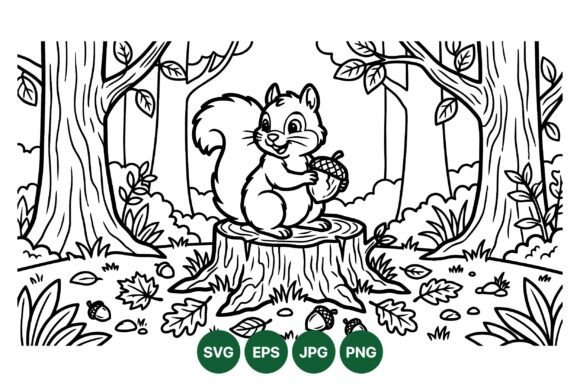
Cute Squirrel Forest Coloring SVG
A Gentle, Handmade Vibe—Right Out of the Hoop
First impression? This isn’t a busy, overworked illustration—it’s a quiet moment in the woods, rendered with soft confidence. The squirrel sits centered and grounded on a tree stump, tail curled just so, acorn held like a tiny treasure. Around it, leaves unfurl with gentle variation—not identical clones, but natural siblings—and distant trees fade into subtle line work. As an embroidery designer who’s stitched hundreds of nature motifs, I immediately felt its rhythm: calm, unhurried, and deeply wearable. It doesn’t shout. It invites.
Where It Shines: Real Projects, Real Customers
I tested Cute Squirrel Forest Coloring SVG as the centerpiece for a custom embroidered linen tote bag—intended for a local botanical café’s gift shop. The result? A product that looked thoughtfully made, not mass-produced. Customers paused at the display, traced the squirrel’s outline with their fingers, and asked, “Is this hand-drawn?” That’s the power of clean black-and-white line art in embroidery: it reads as intentional, artisanal, and quietly joyful.
It works especially well for:
- Baby embroidery—on organic cotton onesies or burp cloths, where simplicity and softness matter more than flash;
- Embroidered patches—stitched onto denim jackets or backpacks, where the balanced negative space lets the design breathe;
- Sweatshirt embroidery—centered on the chest or back, where the moderate scale (neither too dainty nor overwhelming) feels cozy and confident;
- Kitchen towels and tea towels—where the forest motif adds warmth without cluttering function;
- Nursery decor—framed as a hoop art piece or stitched onto a pillow cover, reinforcing a peaceful, nature-based aesthetic;
- Personalized gifts—paired with a child’s name in a simple sans-serif font below, it becomes heirloom-level thoughtful.
Where to Pause—and Plan Ahead
This isn’t a one-size-fits-all embroidery file. Its charm lies in its detail—but that same detail asks for attention during execution. The leaf veins, the texture of the tree bark, the delicate curve of the squirrel’s ear—they all translate beautifully… if you’re stitching on stable, medium-weight fabric with proper stabilizer support.
Use caution with:
- Small hoop sizes (under 4”): The composition fills space gracefully, but compressing it too far risks losing definition in the leaves and stump grain;
- Stretchy or thin fabric (like jersey or lightweight rayon): Without cutaway stabilizer and careful hooping, fine lines can blur or pucker;
- Dark fabric: Since it’s black-and-white line art, contrast depends entirely on thread choice—test white, ecru, or light sage on charcoal or navy before committing;
- Curved surfaces (caps, curved apron pockets): The bottom-heavy layout means the stump anchors the design well, but avoid placing it too close to seams or brims where distortion is likely;
- Frequent-wash items (baby bibs, dish towels): Confirm stitch density isn’t overly sparse—running stitches alone won’t hold up; a mix of satin and fill elements (if adapted from the SVG) helps durability.
What It Adds—Beyond the Stitch
Cute Squirrel Forest Coloring SVG does more than decorate—it signals care. In a market flooded with generic animal icons, this design carries personality without kitsch. That matters for your brand. When an Etsy seller uses it on a set of handmade kitchen linens, buyers don’t just see a squirrel—they sense intention, seasonal warmth, and quiet craftsmanship. That builds trust faster than any product description.
It also elevates perceived value. A plain tote becomes a boutique item. A basic sweatshirt gains storytelling weight. And because it’s rooted in coloring-book style, it subtly invites interaction—ideal for craft fairs where customers enjoy imagining how they’d personalize it (with thread color, placement, or pairing).
Practical Designer Notes—Before You Stitch
As someone who’s learned the hard way: never skip the test run. Here’s what I do before using Cute Squirrel Forest Coloring SVG in a client project or shop listing:
- Stitch a sample on scrap fabric matching your final material—especially if it’s textured (like terry cloth) or loosely woven (like linen);
- Check thread color contrast in natural light and under store lighting—what looks crisp on screen may soften on fabric;
- Review stitch density in your embroidery software: look for areas where fine lines might collapse into solid blobs or disappear entirely;
- Confirm hoop size compatibility—this design fits comfortably in a 5x7 hoop, but verify before digitizing or purchasing a pre-digitized version;
- Inspect small details at actual stitch size: the acorn’s cap, the leaf tips, the eye—do they read clearly, or vanish into noise?
- Test black-and-white mockups on both light and dark backgrounds—this helps predict how your finished product will photograph for Etsy or Instagram;
- Use appropriate stabilizer: medium-weight cutaway for knits, tear-away for stable wovens, and fusible for lightweight layers;
- Verify licensing before selling finished items or bundling the SVG with other digital products—since it’s categorized as Illustrations and Graphics, commercial use rights aren’t implied unless explicitly stated by the creator.
Final Thought: A Design That Grows With Your Work
Cute Squirrel Forest Coloring SVG isn’t flashy—but it’s reliable, expressive, and quietly versatile. It fits seamlessly into a craft business’s seasonal rotation (spring baby items, autumn kitchen goods, year-round nursery pieces), supports multiple product types without feeling repetitive, and holds up across embroidery, print, and even hand-stitching applications. For designers, sellers, and makers who value authenticity over algorithm-chasing, it’s the kind of asset that earns repeat customers—not because it’s loud, but because it feels like home.