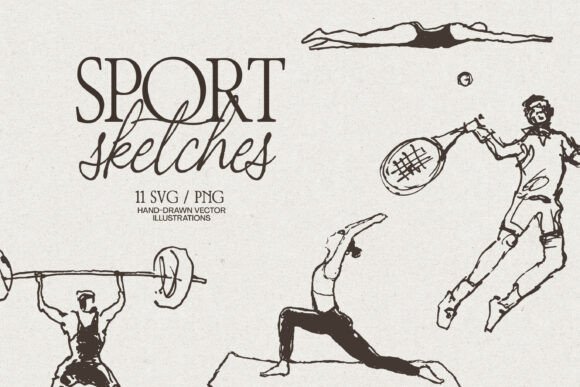
Sport Activity Sketches
First Impressions: Raw Energy, Not Rigid Precision
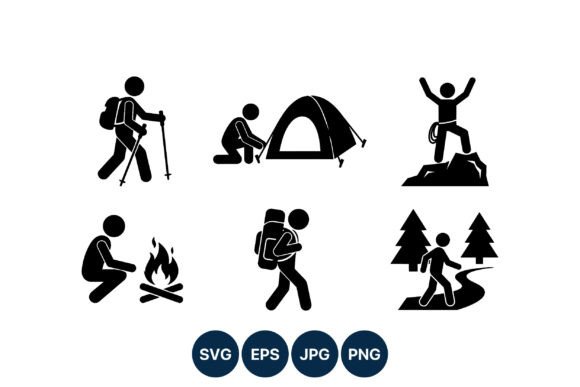
Opening Sport Activity Sketches feels like flipping through a designer’s sketchbook mid-sprint—loose, intentional, alive. This isn’t clipart masquerading as art. It’s expressive hand-drawn linework that captures motion: the quiet tension of a yoga warrior pose, the torque and release in a tennis serve, the grounded momentum of a runner mid-stride. The mood is human, not mechanical—confident but approachable, energetic without being chaotic. As an embroidery designer who’s stitched hundreds of illustrations, I immediately sensed its strength: it leans into imperfection as personality. That means it’ll read beautifully on handmade products where charm matters more than pixel-perfect symmetry.
Where It Shines: Real Projects, Real People
Last week, I used one of the yoga sketches to embroider a linen tote bag for a local wellness studio’s pop-up event. No digital mockup could’ve predicted how well the sketch’s uneven line weight held up at 4.5" wide on natural fiber—slight variations in stitch density actually enhanced the hand-drawn feel. Customers paused, pointed, smiled. “That looks like *me* trying downward dog,” one said. That’s the magic of Sport Activity Sketches: it invites recognition, not just decoration.
It’s equally effective on sweatshirt embroidery—especially crewnecks and relaxed-fit hoodies—where bold linework reads clearly from across a room. On baby embroidery? Choose the gentler poses (a seated stretch, a kneeling balance) and scale down to 3–3.5". Paired with soft pastel thread colors on organic cotton onesies, it reads tender and thoughtful—not athletic in a competitive sense, but in a joyful, embodied way. For embroidered patches or aprons worn by fitness instructors or physical therapists, the collection adds quiet professionalism with warmth. And yes—it works for holiday embroidery too: imagine a subtle tennis sketch on a tea towel gifted to a coach, or a runner motif on a kitchen towel for a marathoner’s birthday. It’s versatile, but never generic.
Where to Pause—and Test First
Sport Activity Sketches isn’t built for micro-detail work. If you’re planning a machine embroidery design for a curved cap front or a tiny baby cap (under 2.5"), examine the sketch closely: look for tight corners, overlapping limbs, or thin connecting lines. Those areas may collapse or blur under dense fill stitch or on stretchy fabric without proper stabilizer. On textured fabrics like terry cloth or bouclé knits, the linework stays legible—but avoid placing it over seams or high-contrast fabric joins where registration shifts can exaggerate line wobble.
Dark fabric demands attention. Because these are Graphics rooted in contrast and gesture—not flat silhouettes—thread color choice is critical. A charcoal gray satin stitch on black twill will disappear; go for off-white, heathered ecru, or even a muted sage green for depth and clarity. Always test the embroidery file on scrap fabric first, using your intended stabilizer combo (cutaway + tear-away often works best for active linework). Check how small details—like the curve of a wrist or separation between fingers—translate in running stitch. If they vanish, simplify manually or choose a larger-scale sketch from the set.
Design Assets That Build Trust—Not Just Looks
When customers see Sport Activity Sketches on a finished product, they don’t see “illustration.” They see intention. That tells them you chose something with voice—not just something that fit the hoop. That perception lifts perceived value: a $28 embroidered pillow cover feels like a curated object, not a craft fair afterthought. For Etsy sellers and small shop owners, that translates directly to fewer “Is this handmade?” questions and more repeat buyers who recognize your aesthetic consistency.
It also strengthens brand storytelling. A boutique selling mindful activewear doesn’t need aggressive logos—they need visual cues that align with calm focus and movement. Sport Activity Sketches delivers that quietly, without shouting. Same for personalized gifts: a custom embroidered sweatshirt with a runner sketch for a friend’s first 5K lands differently than a stock font name. It feels seen.
Practical Notes Every Embroidery Designer Should Keep Handy
- Test before committing: Run a full-size sample on your target fabric + stabilizer combo—even if it’s just one pose. Watch how corners stitch, how line ends taper, how thread tension handles quick directional changes.
- Check stitch density: These are Illustrations designed for expression, not coverage. Avoid adding heavy fill stitches unless the original file includes them intentionally—extra density can mute the sketch’s lightness.
- Hoop size matters: Most sketches scale cleanly between 3" and 6", but verify minimum clearances for your machine’s throat space—especially for larger compositions with extended limbs.
- Thread colors make or break it: Try your top three thread options in black-and-white printable mockups first. What reads as confident in grayscale will hold up through washes and wear.
- Confirm licensing early: Since Sport Activity Sketches is marketed as Graphics for commercial use, double-check whether your intended application (e.g., selling embroidered patches wholesale or bundling the embroidery file with a craft kit) falls within the license scope. When in doubt, contact the creator directly—clarity now prevents headaches later.
- Respect the medium: Don’t force it onto ultra-thin silk or highly elastic performance knit without testing. Its strength lies in authenticity—not adaptability to every substrate.
Final Thought: It’s Not Just a Design—It’s a Conversation Starter
I keep Sport Activity Sketches in my go-to folder for projects where the customer wants meaning, not just markup. Whether it’s a custom embroidered tote bag for a yoga retreat, a set of kitchen towels for a physical therapy clinic, or a limited-run patch series for a community run club—it consistently bridges function and feeling. It doesn’t try to be everything. It knows its voice: grounded, kinetic, human. And in a market flooded with overly polished, algorithm-friendly graphics, that honesty is its strongest stitch.