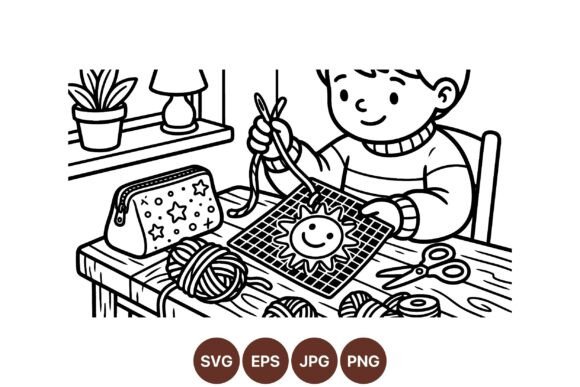
Kids Craft Activity Line Art
A Sun That Smiles—But Does It Stitch Cleanly?
First impression? Warm. Gentle. Uncluttered. Kids Craft Activity Line Art lands like a quiet exhale—soft black-and-white vector lines tracing a smiling sun, a child’s hands at work on a string art board, yarn balls and scissors resting nearby. It’s not bold or flashy; it’s intentionally peaceful, thoughtful, and deeply craft-adjacent. As someone who’s stitched hundreds of designs onto baby onesies, boutique tea towels, and custom aprons, I immediately saw its potential—not as a statement piece, but as a quiet signature. The kind of embroidery that makes a customer pause, smile, and say, “That feels handmade in the best way.”
Where This Design Lives Best (and Where It Might Struggle)
I tested Kids Craft Activity Line Art as a central motif on a natural linen tote bag—lightweight, slightly textured, and destined for a local craft fair. Stitched with soft pastel threads and a medium-weight tear-away stabilizer, the line art translated beautifully: clean curves, open negative space, and just enough detail to read clearly at 4.5 inches wide. It looked intentional, not generic. That’s rare.
It shines on items where simplicity reads as care: baby burp cloths, nursery wall hangings, embroidered patches for preschool staff aprons, or minimalist sweatshirt fronts for small shop branding. On a cream-colored organic cotton onesie? Perfect. The design breathes. No overcrowding. No visual noise.
But here’s where attention matters: Kids Craft Activity Line Art isn’t built for dense fill stitch areas or tight satin borders. There’s no heavy outlining or nested layers—so if you’re planning an applique design or a high-contrast patch with sharp edges, this isn’t your base layer. It’s a line art illustration first, not a ready-to-stitch machine embroidery design. You’ll need to digitize thoughtfully—or source a pre-digitized version with appropriate stitch types (running stitch for light outlines, sparse fill for subtle texture).
Fabric & Fit: Know Before You Hoop
This design responds well to stable, medium-weight fabrics—linen, quilting cotton, twill, even midweight denim. But tread carefully on stretchy knits (like jersey t-shirts) without proper cutaway stabilizer and careful hooping. The delicate curves around the sun’s rays and the child’s fingers can distort if the fabric shifts even slightly.
On dark fabric? Test thread contrast rigorously. The original is black-and-white vector art—so grayscale mockups are essential before stitching. A pale yellow thread may vanish on charcoal; a navy might disappear on indigo. And avoid placing it near seams, curved surfaces (like cap brims), or layered garments (think reversible baby blankets)—the open line work doesn’t anchor itself visually the way denser motifs do.
Small hoop sizes (under 4”) demand editing: simplify the desk outline or crop tightly to the sun + child’s hands. Tiny details—like individual yarn strands or scissor blades—won’t resolve cleanly below 3 inches without manual redrawing or strategic simplification.
What It Adds (and Doesn’t Add) to Your Finished Product
Kids Craft Activity Line Art elevates perceived value by signaling intentionality—not just decoration. Customers browsing Etsy for personalized baby gifts or boutique kitchen towels respond to its calm authenticity. It says “handmade with care,” not “mass-produced clip art.” That builds trust, especially for small shop owners curating cohesive, story-driven collections.
It also supports brand consistency beautifully when used across product families: same sun motif on a tea towel, matching pillow cover, and printable gift tag. But—and this matters—it doesn’t carry strong commercial “pop.” It won’t dominate a tradeshow booth or scale boldly on a large tote. Its strength is subtlety, not saturation.
For holiday embroidery? Think Easter baskets, spring baby showers, or teacher appreciation kits—not Halloween or Christmas markets. For wedding gifts? A linen napkin set with this motif stitched in ecru thread feels quietly celebratory. For personalized gifts? Yes—but pair it with a name or date in a clean, legible font, not tucked into the design itself. The line art doesn’t leave room for embedded text without compromising clarity.
Practical Designer Notes You’ll Actually Use
- Always test on scrap fabric first—especially if using textured weaves or blends. Linen’s slubs can catch fine lines; bamboo rayon may shift under tension.
- Review stitch density manually if digitizing yourself. This isn’t a high-stitch-count file—so avoid overloading it with unnecessary underlay or dense fills that muddy the line art’s lightness.
- Confirm hoop size compatibility before finalizing production. The full scene fits comfortably in a 5×7 hoop—but cropping to focus on the sun alone opens up 4×4 options.
- Inspect small details at actual stitch-out size: those yarn balls and scissors are charming, but they’re not structural. If your end use prioritizes durability (e.g., toddler clothing), consider omitting or simplifying them.
- Test black-and-white mockups on both light and dark backgrounds. This design relies on contrast—so verify readability before committing thread or fabric.
- Use appropriate stabilizer: medium-weight tear-away for stable wovens; cutaway for knits or loosely woven fabrics.
- Verify licensing before selling finished products or digital embroidery files. As an Illustration and Graphics asset, Kids Craft Activity Line Art may require extended licenses for commercial embroidery use—don’t assume standard use covers resale of stitched goods.
Final Thought: A Quiet Asset, Not a Quick Fix
Kids Craft Activity Line Art won’t solve every embroidery challenge—and it shouldn’t try to. Its value lies in its restraint. It works because it doesn’t shout. When stitched cleanly on the right fabric, at the right scale, with thoughtful thread choices, it becomes more than decoration: it’s a small moment of calm, stitched by hand and chosen with purpose. For Etsy sellers building a gentle, nature-inspired brand—or craft business owners curating meaningful, washable baby embroidery—it’s a quiet keeper. Just remember: respect its simplicity. Don’t force it where it doesn’t belong. Let it breathe. And always, always test first.