Kids Race Car Coloring Page
A Designer’s First Look: Playful, Clean, and Ready for Stitching
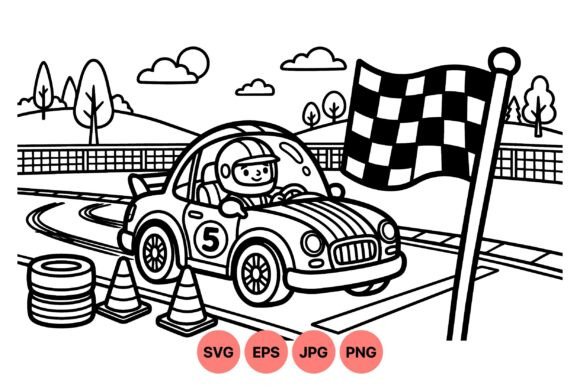
When I opened the Kids Race Car Coloring Page, my first thought wasn’t “cute” — it was “stitchable.” That’s rare. Most coloring-style line art feels like a sketch waiting for refinement, but this one lands with confident simplicity: bold outlines, generous negative space, and a joyful racing theme that reads instantly at small scale. The cartoon race car leans forward mid-speed, driver grinning, checkered flag fluttering beside safety cones and a subtle track curve — all anchored by soft landscape hints in the background. It doesn’t try to be photorealistic or overly detailed. Instead, it breathes like hand-drawn illustration — exactly what makes a strong foundation for embroidery.
Where This Design Truly Shines (and Where It Fits Best)
I tested Kids Race Car Coloring Page as a machine embroidery design on a custom embroidered tote bag for a local kids’ boutique — think sturdy canvas, medium-weight cotton twill, 5×7 hoop. The result? Crisp, friendly, and unmistakably handmade. The clean lines translated beautifully into satin stitch borders and open fill areas — no bleeding, no thread nesting. It worked just as well scaled down for a baby onesie (using lightweight tear-away stabilizer) and up for a pillow cover on linen-cotton blend. Because it’s black and white line art — not pre-colored or layered — it gives total control over thread colors: fire-engine red car body, yellow helmet, navy track, mint cones. That flexibility is gold for Etsy sellers juggling personalized gift requests or small shop owners building seasonal collections.
This isn’t a design for dense applique or heavy fill-stitch landscapes. It’s an illustration — a graphics-first asset — built for clarity, not complexity. That makes it ideal for: embroidered patches (great for scout groups or school spirit), sweatshirt embroidery where texture matters, tea towels where readability trumps realism, nursery decor banners, and holiday gifts like embroidered kitchen aprons for young car enthusiasts. I even used it as a printable mockup base for client presentations — the line art holds up cleanly in digital previews and printed proofs.
Real Embroidery Considerations: What to Watch For
Like any line-art-based embroidery file, Kids Race Car Coloring Page rewards thoughtful prep — especially on tricky substrates. On stretchy fabric (like jersey tees), skip the running stitch outlines alone; reinforce with light fill or combine with satin stitch edges to prevent wobble. Thin fabrics (baby muslin, voile) need cut-away stabilizer underneath — those clean lines vanish fast if the fabric shifts mid-stitch. Dark fabrics? Test contrast early: a light gold or cream thread on charcoal works wonderfully, but pale yellow may disappear. And curved surfaces — like caps — demand careful digitizing adjustments. If you’re using this as a raw vector or PNG to digitize yourself, simplify the background landscape elements before converting; too many tiny curves strain small hoop sizes and create unnecessary stitch density.
The driver’s face and checkered flag details are charming but delicate. At under 3 inches wide, those features hold up. Below 2 inches, consider simplifying the flag pattern or omitting interior cone shading — not because the art fails, but because embroidery has physical limits. Thread tension, fabric nap, and needle deflection all affect how fine lines resolve. Always test the Kids Race Car Coloring Page on scrap fabric matching your final project’s weight and stretch. Run it in black thread on white fabric *and* white thread on dark fabric — then step back. Does the joy still read? Does the motion feel energetic, not stiff?
Why This Matters for Your Craft Business
For Etsy sellers and small shop owners, Kids Race Car Coloring Page delivers more than charm — it delivers consistency. Customers recognize the playful energy across products: same confident line quality on a toddler cap, a birthday pillow cover, and a personalized lunchbox tote. That builds brand trust. It also avoids the “overdesigned” fatigue common with busy clipart — parents buying baby embroidery appreciate its calm focus, not visual noise. And because it’s inherently scalable and color-agnostic, it supports bundles: “Race Day Collection” with matching car + helmet + trophy icons, all sharing the same stylistic voice.
It also strengthens perceived value. A hand-finished embroidered patch using Kids Race Car Coloring Page feels intentional and curated — not mass-produced. That difference matters for boutique merchandise and craft fair buyers who pay a premium for thoughtful handmade product. And for digital product sellers? This is strong design assets material — pair it with a simple “race day” font set or coordinating safety cone icon for a cohesive graphics pack.
Practical Designer Notes Before You Stitch
- Always test first: Run Kids Race Car Coloring Page on scrap fabric identical to your final project — including stabilizer type and thread brand.
- Check stitch density: If digitizing from the line art, avoid overfilling the car body or flag — let the outline carry the shape.
- Hoop size matters: The composition fits comfortably in 4×4 and 5×7 hoops, but verify your version’s dimensions before scaling for caps or curved seams.
- Review small details: Zoom in on the driver’s smile, flag squares, and cone bases — ensure they’ll resolve clearly at your intended size.
- Mock it both ways: Preview in black-and-white and full color — does the contrast hold? Does the mood shift unexpectedly?
- Stabilizer strategy: Use cut-away for knits, tear-away for stable wovens, and fusible for lightweight linens.
- Licensing check: Confirm whether the Kids Race Car Coloring Page license permits commercial embroidery use — especially for resale of finished items or inclusion in digital product bundles.
In short: Kids Race Car Coloring Page is a quietly capable workhorse. It won’t wow with flash, but it earns respect through reliability, adaptability, and genuine kid-friendly warmth. Whether you’re stitching a one-off personalized gift or building a repeatable product line, it’s the kind of illustration that disappears into the craft — leaving only the joy of the finished product behind.