Warm Kitchen Baking Coloring Book: Graphics & Coloring Pages Amp
First Impression: Cozy, Handmade, and Warmly Inviting
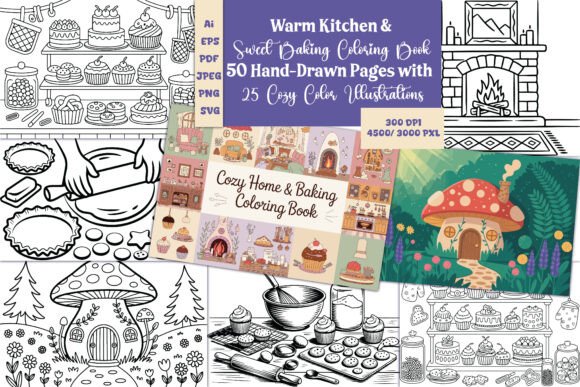
Opening Warm Kitchen Baking Coloring Book, I immediately sense a quiet confidence — not loud or trendy, but deeply human. The illustrations evoke the soft glow of a vintage oven light, flour-dusted countertops, and steam curling from mugs. It’s not “cute” in a juvenile way; it’s comforting, with gentle linework, balanced negative space, and subtle textural warmth. For a local business, this graphic design asset suggests a brand personality that’s approachable yet intentional — think artisanal bakery, small-batch candle studio, handmade soap brand, or seasonal home decor boutique. It reads as organic, feminine-adjacent (but not exclusively), gently rustic, and quietly festive — ideal for businesses building emotional resonance over algorithmic virality.
Where This Asset Earns Its Place in Real Local Business Branding
I recently used Warm Kitchen Baking Coloring Book to refresh packaging and social assets for “Hearth & Honey,” a family-run honey shop and café in Portland. What made it work wasn’t just charm — it was versatility across touchpoints. As a core graphic design asset, it supported:
- Product labels: A single cupcake outline, recolored in amber and cream, became a subtle watermark behind raw honey jar labels — adding warmth without obscuring ingredient clarity.
- Packaging accents: The cozy kitchen interior illustration scaled beautifully as a debossed foil accent on kraft gift boxes — reinforcing brand identity without overwhelming the tactile experience.
- Social media graphics: Isolated baking scenes served as elegant backgrounds for Instagram carousels announcing seasonal flavors — boosting visual hierarchy and scroll-stopping appeal.
- Printable inserts: Printed on seeded paper, pages doubled as thank-you cards tucked inside orders — turning functional communication into a branded, shareable moment.
- Seasonal campaign visuals: Paired with hand-lettered typography and warm-toned photography, the illustrations anchored a holiday “Bake & Belong” campaign across posters, email headers, and in-store banners.
Why It Strengthens Small Business Presentation
For local businesses competing on authenticity — not ad spend — Warm Kitchen Baking Coloring Book delivers tangible branding leverage. It supports stronger first impressions by replacing generic stock art with cohesive, mood-aligned visuals. Product recognition improves because customers begin associating those gentle baking motifs with your brand’s warmth and care. Visual hierarchy sharpens when illustrations act as intentional framing devices — guiding eyes to pricing, ingredients, or calls-to-action. Most importantly, it builds customer trust: consistent, thoughtful design signals professionalism and respect for the buyer’s experience. Shelf appeal rises, especially in crowded farmers’ markets or indie boutiques where tactile and aesthetic polish differentiate handmade business from commodity.
Best Fit Use Cases — Where It Shines
This graphic design asset performs strongest where warmth and narrative matter most: product mockups for food labels or candle jars, hero graphics for website banners, decorative brand elements on thank-you cards or hang tags, promotional banners for holiday pop-ups, seasonal packaging (think cinnamon roll gift sets or spring tea blends), boutique visuals for window displays, and social media campaign graphics built around storytelling — like “Meet Our Baker” reels or “Behind the Batter” newsletters.
Use With Intention — Not Everywhere
It’s not universal. Avoid forcing Warm Kitchen Baking Coloring Book into formal corporate branding, legal-heavy layouts (e.g., supplement facts panels), or ultra-minimalist luxury contexts where restraint is the message. Don’t scale it too small on product labels — fine linework blurs below 0.25” height in print. Steer clear when decoration competes with critical text, like ingredient lists or allergen statements. And skip it on low-contrast backgrounds (e.g., light gray on beige) unless you’ve verified legibility in final output.
Practical Brand Designer Notes Before You Launch
Before integrating into client work or your own small business branding:
- Test it on real packaging mockups — both flat and 3D — to assess scale, balance, and material interaction (e.g., how it reads on matte kraft vs. glossy white).
- Check black-and-white usage: does line weight hold? Will it reproduce cleanly on thermal receipt printers or basic inkjet labels?
- Preview on small labels — zoom to actual size on screen, then print at 100% to verify detail retention.
- Test alongside your brand colors: does the line art harmonize with your palette, or fight it? Try overlays, tints, and spot-color fills.
- Compare against competitor packaging — does it elevate your distinctiveness, or blend in?
- Review PNG transparency: are edges crisp? Are there stray pixels or anti-aliasing halos?
- If SVG or vector files are included, confirm editability — can you isolate elements, adjust stroke weight, or recolor without rasterization?
- Test beside serif, sans serif, script, handwritten, and display fonts — does it support your typographic voice or distract from it?
- Verify commercial licensing explicitly — especially for physical product sales, resale items, or client-facing branding. Not all creative marketplace assets permit commercial design use out of the box.
A Thoughtful Tool for Human-Scale Branding
Warm Kitchen Baking Coloring Book isn’t just clipart — it’s a mood anchor, a visual shorthand for care, craft, and connection. When applied with intention, it becomes part of a broader brand identity system: supporting logo design through complementary styling, elevating packaging design with narrative depth, and enriching marketing visuals with emotional texture. For food businesses, handmade sellers, and local brands building loyalty one thoughtful detail at a time, it’s less about filling space — and more about inviting people in.