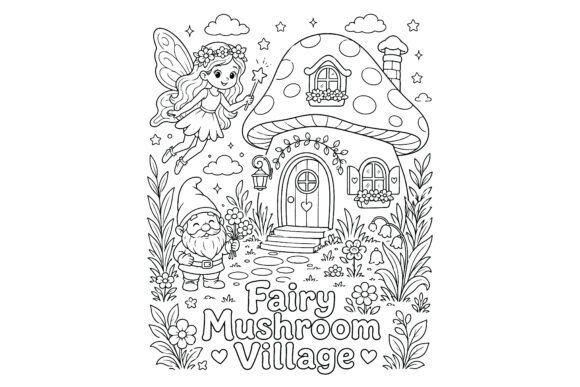
Fairy Mushroom House Coloring Page
First Impression: Whimsy That Translates—If You Guide It Right
Opening Fairy Mushroom House Coloring Page, I felt that familiar spark—the kind you get when a design whispers, “I belong on something handmade.” It’s not overly complex, but it’s rich in narrative: rounded mushroom caps, friendly faces peeking from doorways, winding stems, dainty flowers, and soft cloud-like foliage. The line work is confident—not too thin, not too heavy—and the negative space breathes. As an embroidery designer who’s stitched everything from nursery onesies to boutique aprons, I immediately saw its potential—but also its boundaries. This isn’t a standalone logo or monogram; it’s a scene. And scenes need thoughtful translation into stitch.
A Real-World Test: Embroidering It on a Linen Tea Towel for a Local Gift Shop
Last month, I prepped Fairy Mushroom House Coloring Page as the centerpiece for a limited-run linen tea towel series—meant for a small-town gift shop’s spring collection. My goal? A hand-finished look that felt intentional, not “printed-and-embroidered.” I traced the outline onto stabilizer, digitized key elements (not the full coloring page), and built a hybrid design: satin-stitched mushroom caps, gentle fill-stitch grass, and running-stitch vines. Why not stitch the whole thing as-is? Because raw coloring pages aren’t embroidery files—they’re starting points. Without simplification, those tiny flower centers would vanish under thread, and the overlapping stems would create dense, stiff patches. The magic of Fairy Mushroom House Coloring Page lies in its flexibility—not its plug-and-play readiness.
Where It Shines (and Where It Needs Editing)
Fairy Mushroom House Coloring Page works beautifully for:
- Personalized baby items: Stitched small on a cotton onesie or burp cloth—especially with soft pastel thread colors—it reads as tender, storybook charm.
- Tote bag designs: At 4–5 inches wide, it anchors the front panel without overwhelming. Pair it with a simple running-stitch border or a single embroidered phrase (“Grow Wild”) for cohesion.
- Pillow covers & nursery decor: Its organic shapes soften modern interiors. On linen or canvas, it reads as heirloom-quality—not craft-store generic.
- Holiday or birthday gifts: Think embroidered kitchen towels for gardeners, or patch sets for kids’ backpacks. Its fantasy tone lands gently, never cloying.
But proceed with care on:
- Stretchy fabrics like knits or lightweight jersey—without firm cutaway stabilizer, the curves can warp and blur detail.
- Dark fabric backgrounds: Those delicate inner lines won’t read unless you use high-contrast thread (e.g., ecru on navy) or add subtle underlay stitches.
- Caps and curved surfaces: The asymmetrical layout doesn’t wrap well. Better suited for flat panels—aprons, tote fronts, pillow centers—than structured headwear.
- Small hoop sizes (under 4”): Scaling down compresses the fairy-gnome scale relationships. Prioritize one focal element—like the largest mushroom—rather than shrinking the whole scene.
What It Adds to Your Craft Business—Beyond Aesthetics
As an Etsy seller and small shop owner myself, I pay attention to how a design affects buyer trust and perceived value. Fairy Mushroom House Coloring Page elevates handmade presentation because it feels curated—not stock. Customers recognize intentionality: the way the mushrooms tilt just so, how the leaves curl outward, the balance between detail and openness. That translates directly to higher engagement in listings, better photo mockups, and stronger repeat interest. It also supports brand consistency if your shop leans into nature-meets-fantasy (think botanical embroidery studios or cottagecore-themed boutiques). Just remember: using it commercially means verifying licensing—especially since it’s listed under Freebies and categorized as Graphics. Not all free graphics permit resale of finished embroidered goods.
Practical Designer Notes Before You Stitch
Before committing thread and time:
- Test on scrap fabric first—especially if using textured weaves like burlap or terry cloth. Those fine stems may snag or disappear.
- Check thread color contrast early. What reads as “soft green” on screen might blend into olive linen. Try stitching a single cap in three shades.
- Review stitch density. Heavy fill areas (like mushroom caps) benefit from reduced density on lightweight fabrics to avoid stiffness.
- Confirm hoop size compatibility. If digitizing yourself, build around standard 4x4 or 5x7 hoops—not oversized commercial frames.
- Inspect small details at actual stitch size: those fairy eyes or flower centers need at least 1.5mm clearance to stay legible.
- Mock it in black and white—this reveals tonal balance better than color previews. Does the scene hold shape without hue cues?
- Use proper stabilizer: medium-weight cutaway for stable wovens, tear-away for temporary layers on smooth cotton.
- Verify usage rights. Since this is a Graphics-type freebie, confirm whether derivative embroidery files or finished products are permitted for sale.
The Bottom Line for Makers Who Value Craft Over Convenience
Fairy Mushroom House Coloring Page isn’t a shortcut—it’s a prompt. It invites you to slow down, choose where detail matters most, and decide how much whimsy your customer truly wants to feel in their hands. Used thoughtfully, it becomes more than decoration: it’s storytelling in thread, warmth in stitch, quiet magic on everyday objects. Whether you’re embroidering a holiday gift for a niece, building a cohesive line for your Etsy shop, or designing custom apparel for a local café’s staff, this design rewards attention—not automation. And in our world of handmade product and digital embroidery file curation, that’s the rarest kind of asset.